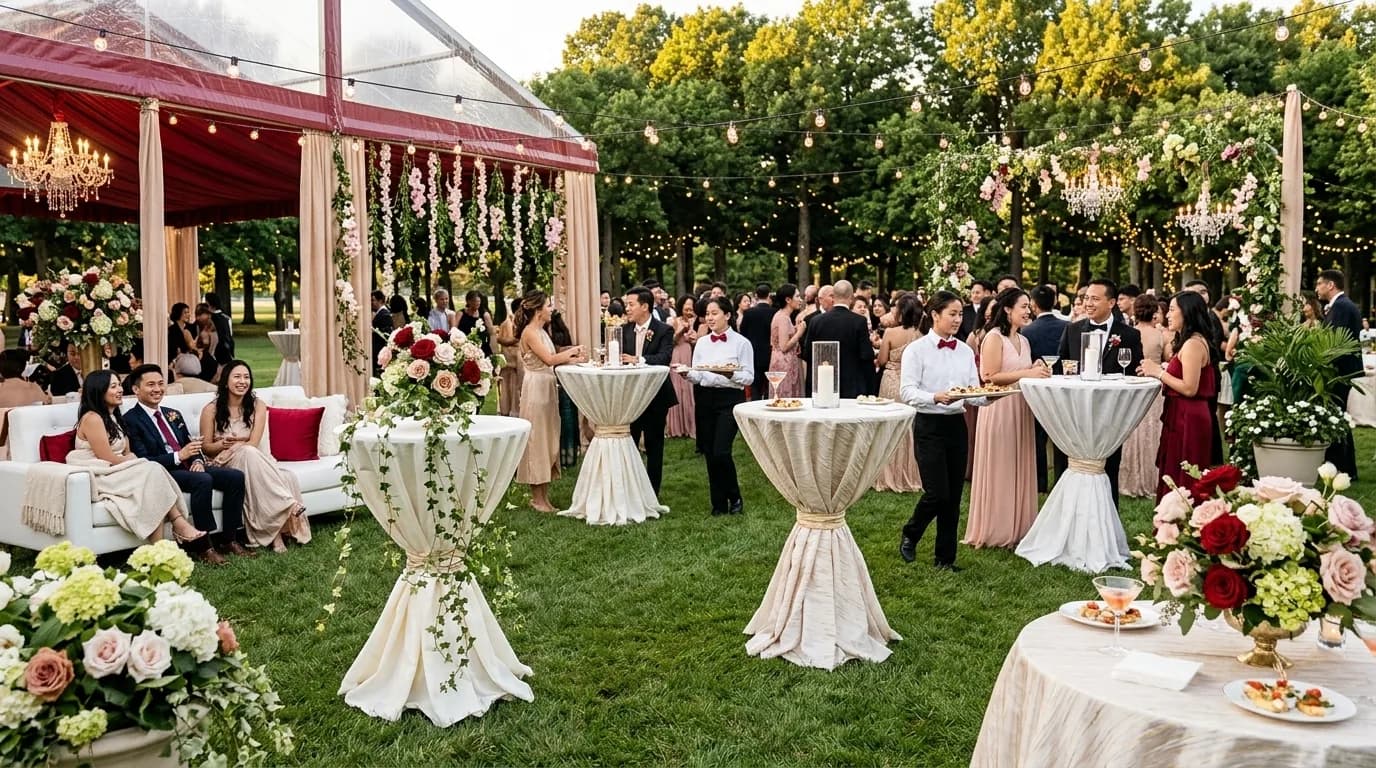
Fans and Evaporative Coolers for Summer Events: What Works in Chicago
How to keep guests cool at a summer tent or backyard event with fans and evaporative coolers, including how many to rent, where to place them, and humidity limits.

Summer in Chicago means a beautiful evening for a wedding, and sometimes a heat index that makes the tent feel like a greenhouse. Open sidewalls help, but tents trap heat, and formal clothing makes it worse. Fans are the quiet hero. This guide explains which cooling tools work, how to place them and what to ask for.
Fans versus coolers versus air conditioning
| Tool | How it helps | Limits |
|---|---|---|
| Pedestal fan | Moves air across skin | Does not lower temperature |
| Drum or high-velocity fan | Moves more air, farther | Loud, can blow decor |
| Misting fan | Adds fine mist that cools by evaporation | Wets surfaces, less effective in humid air |
| Evaporative cooler (swamp cooler) | Cools air through evaporation | Works best in dry air, needs water and power |
| Portable air conditioner | Lowers air temperature | Needs heavy power and sealed spaces |
| Tent air conditioning (ducted) | Cools the whole tent | Large power and special setup |
The key concept is humidity. Evaporative cooling needs dry air to evaporate water. When the air is already humid, evaporation slows and the effect shrinks. Chicago summers vary, with some dry days and many sticky ones, so ask your supplier how a given cooler performs at the humidity you expect, and rely on fans as the baseline.
How many and where
A reasonable starting point is one large fan per 150 to 250 square feet of seated area, more for crowded spaces. A 40 x 60-foot tent has 2,400 square feet, so a full dining tent may use 8 to 12 fans. These are rules of thumb. Ask your supplier for their guidance for your tent and weather.
Placement tips:
- Aim fans across the room, not at faces. A steady breeze at 6 feet feels good, while a gale at the dinner table dries food and blows napkins.
- Raise fans off the floor. A fan at head height cools more than one at ankle height.
- Keep them away from candles, lightweight decor and food stations.
- Open the sidewalls on the upwind and downwind sides so air moves through. A closed tent stays hot even with fans.
- Leave walkways clear. Tape or cover cords; see cords on grass.
Power
A pedestal fan draws modest power, and misting or evaporative units draw more. Check the label on each unit, add the watts, and look at generator sizing and event power needs. Spread fans across several outlets, not one. Use outdoor-rated, appropriately thick cords as described in extension cord safety.
- Fan rule of thumb
- 1 per 150 to 250 sq ft
- Fan rule of thumb
- Decides if misting helps
- Humidity
- Decides if misting helps
- Open two opposite sides
- Sidewalls
- Open two opposite sides
- Best fan position
- Head height
- Best fan position
- Spread the load
- 3 outlets
- Spread the load
- Cheapest cooling of all
- Shade
- Cheapest cooling of all
Heat and the schedule
Heat builds through the day, so the hottest part of a reception is often the first hour after dinner, when the tent is full and the sun is still on the fabric. Plan the hottest activities around that. Hold the cocktail hour in shade, serve dinner after the sun drops behind trees or buildings, and keep dancing for last, when the air has cooled. Tell your caterer and band so they can pace service and sets. If the forecast shows a heat advisory, add water stations, give older guests the shadiest seats and tell the venue so staff can watch for guests who feel unwell.
Cooling without equipment
Equipment helps, but the layout and timing help more.
- Schedule the ceremony for late afternoon or evening instead of midday.
- Choose a shaded ceremony site or add a canopy.
- Offer chilled water at the entrance and ice in drinks.
- Offer paper fans or towels as favors that are useful.
- Keep seating compact but not crowded. Our seating guides show how much space each guest needs.
- Use lighter linens and chairs with breathable backs.
- 1Step 1Check the dew pointand forecast heat index.
- 2Step 2Open the tent sidesto create airflow.
- 3Step 3Place fansto circulate across the room.
- 4Step 4Add misting only on dry days
- 5Step 5Test powerand cords before guests arrive.
Chicago notes
The heat index can climb on lake-adjacent days when winds are calm. Rooftop and parking lot sites reflect heat. If your event is in a park, confirm with the park district whether fans, misting equipment and generators are allowed.
Frequently asked questions
How many fans do I need for a tent?
Do evaporative coolers work in Chicago?
Is a misting fan worth it?
Can I air-condition a tent?
Where should fans be placed?
Do fans need special cords?
Keep the guests comfortable
Book a free 15-minute seating call and we will plan seating, shade and cooling together, or request a quote.
- Lighting & Power
- Cooling
- Outdoor Events
Ready to rent?
Keep planning
 How Many Patio Heaters Do You Need for an Outdoor Event?
 Extension Cord Safety for Outdoor Events: Gauge, Length and GFCI
 What Size Generator Do You Need for an Event? A Sizing Guide
 Lanterns and Luminaries for Events: Sizes, Spacing and Safe Options