Quiet Generators for Events: Where to Place Them and How to Hush Them
How to choose a quiet generator for a wedding or party and where to put it, with distance, exhaust and cable run rules for safe, low-noise power.
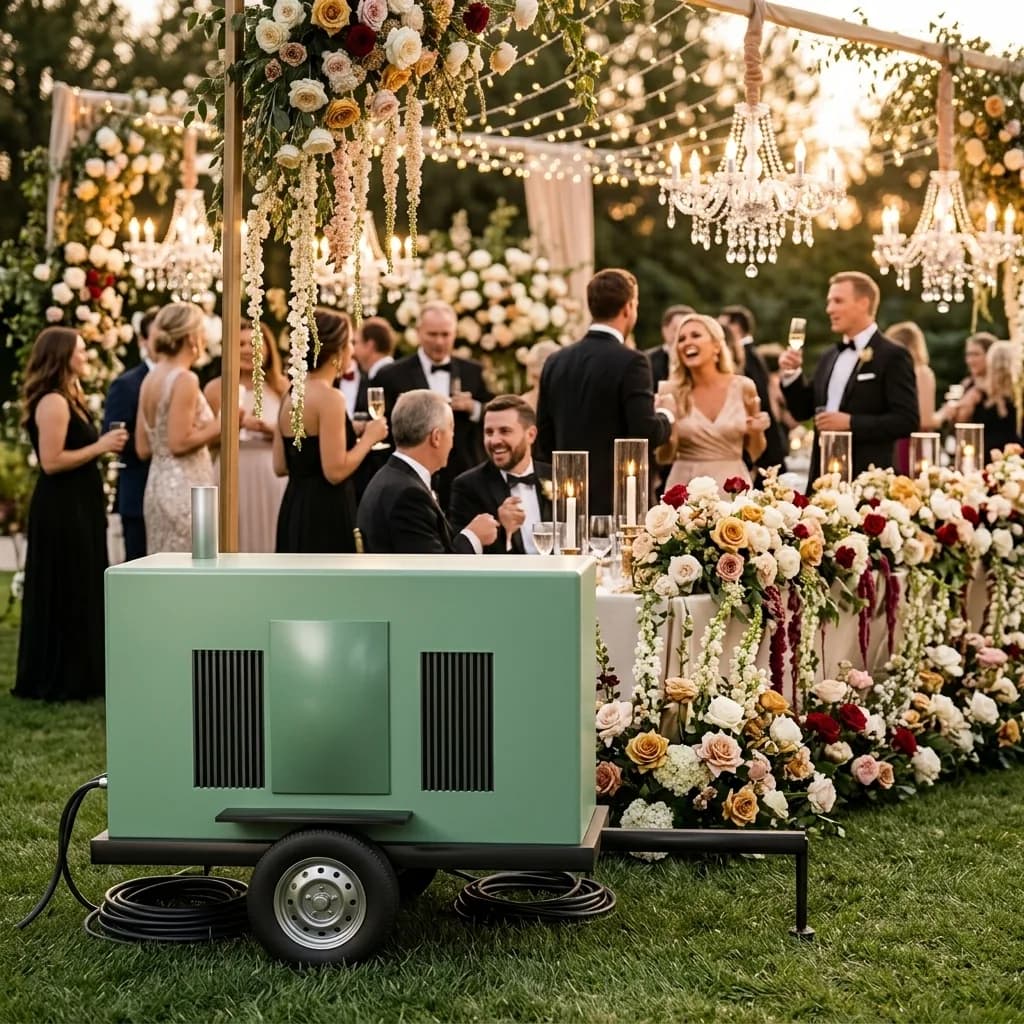
A generator is the one piece of equipment that can make a wedding toast unlistenable. Even a modest unit sounds like a lawn mower from 20 feet away. The fix is not magic. It is picking the right type of unit, placing it with some thought, and running a longer cord. This guide covers all three, plus the safety rules that matter more than the noise.
Why inverter generators are quieter
A conventional open-frame generator runs the engine at a fixed high speed to produce steady power. An inverter generator produces power, cleans it electronically and adjusts the engine speed to the load. At light loads it idles down, which is quieter and uses less fuel. The output is also cleaner, which matters for sound systems and sensitive electronics.
The trade-off is capacity. Inverter units are common in the lower and middle power range and cost more per watt than open-frame units. For a bigger load, many planners run two or three inverter units in parallel, or use a larger sound-attenuated trailer generator.
Read the decibel rating correctly
Manufacturers publish a decibel (dB) figure, but the figure only means something with a distance and a load. Ask:
- At what distance was it measured? A rating taken at 23 feet is not the same as one taken at 3 feet.
- At what load? A quarter load is quieter than full load.
- Is it a shop-measured or a field value? Walls, trees and hard surfaces change the sound.
Sound drops as you move away. As a rule of thumb, every doubling of distance lowers the level by about 6 dB in open space. So moving a generator from 25 feet to 50 feet makes a noticeable difference, and 100 feet makes a bigger one.
Where to put it
- Distance. The farther, the quieter. Use a longer cable instead of a closer unit. Heavier cord is needed for longer runs, so see extension cord safety.
- Downwind. Check the forecast. If the wind will shift, choose a spot that stays downwind most of the day.
- Level, dry ground. Never in standing water. Place on a mat or boards if the lawn is soft.
- Clear space. Follow the manual's clearance requirement on all sides, and keep it away from tent fabric, decorations and anything that can burn. Many guides cite 20 feet from structures and openings for carbon monoxide risk, but follow your manual and local fire officials.
- Out of sight. A decorative fence or a few planters can block the view. Do not block ventilation.
- Never inside. A generator in a garage, shed, tent or covered porch can fill the space with carbon monoxide within minutes. Even an open garage door is not safe.
Sound barriers: what helps and what does not
Solid barriers help only a little. A barrier needs to block the line of sight between the noise and the listener and be dense. Plywood panels around the unit can lower the perceived level, but they trap heat and exhaust, which creates a fire and carbon monoxide risk. Leave generous space for air. A hay bale wall or a hedge reduces higher frequencies, not the low rumble. Distance remains the best tool.
| Option | Effect on noise | Notes |
|---|---|---|
| Inverter generator | Large | Best first step |
| Doubling the distance | About 6 dB less | Needs longer cable |
| Solid barrier, open top | Small to moderate | Keep air flowing |
| Enclosing the unit | Not safe | Heat and carbon monoxide |
| Battery power instead | Eliminates | See battery lighting |
Ask your supplier for a quiet unit
Tell the rental company your event type (a ceremony with spoken vows, a speeches-heavy dinner) and ask for their quietest model. Also ask whether they can supply two small units, one for audio and one for everything else, so the loud load does not affect the sound system. Pair this with a sound system for speeches that sits away from the generator.
- 1Step 1Calculate loadwith the generator sizing guide.
- 2Step 2Choose an inverter typeand read the dB rating and distance.
- 3Step 3Pick a spotdownwind, level and far from guests.
- 4Step 4Run a protected cableand cover crossings.
- 5Step 5Check fuelbefore the ceremony, not during.
Chicago notes
Many suburban villages set quiet hours and noise limits, and parks may restrict generators altogether. Ask your village, your park district or the forest preserve. If you are hosting in a dense neighborhood, tell neighbors ahead of time.
Frequently asked questions
What is the quietest generator for events?
How far should a generator be from a tent?
Can I put a generator in a garage with the door open?
How loud is a generator at 50 feet?
Can I build a box to muffle a generator?
Can I avoid a generator completely?
Plan the power so the toast is quiet
Book a free 15-minute seating call and we will help you plan around power and sound, or request a quote.
- Lighting & Power
- Generators
- Outdoor Events
Ready to rent?
 What Size Generator Do You Need for an Event? A Sizing Guide
 Battery-Powered Event Lighting: Options, Run Times and Charging Plan
 Fans and Evaporative Coolers for Summer Events: What Works in Chicago
 Extension Cord Safety for Outdoor Events: Gauge, Length and GFCI